 EN
EN

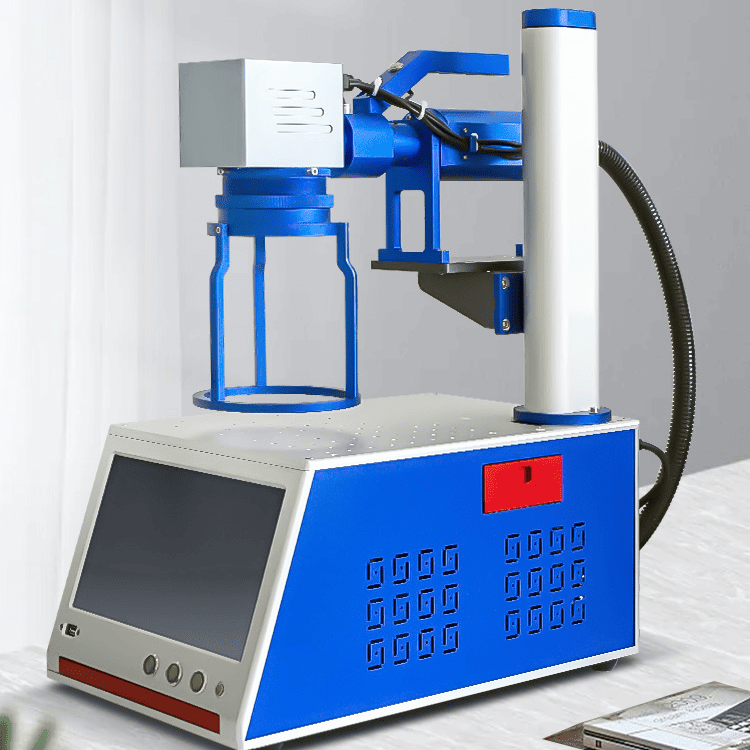
How Fiber Laser Marking Machines Enable Precision Deep Engraving
MOPA vs. Q-switched fiber sources: pulse control, peak power, and thermal management for consistent depth accumulation
Fiber laser marking machines can reach really fine engraving precision down to the micron level thanks to their sophisticated laser setups. The MOPA system, which stands for Master Oscillator Power Amplifier, lets operators adjust pulse widths between 2 and 500 nanoseconds. This gives them better control when removing material because they can manage how much energy gets deposited without causing unwanted thermal damage. On the flip side, Q-switched lasers produce fixed short pulses with much higher peak power sometimes reaching up to 25 kilowatts. These work great for fast vaporization but come with risks like forming recast layers or creating tiny cracks deeper inside materials. Heat management matters a lot here. With MOPA's adjustable pulse settings, there's about 20% less heat buildup compared to Q-switched systems. That makes it possible to do multiple passes during engraving while keeping depth variations under 5% even after hundreds of cycles according to tests from last year's Beam Quality Analysis report. For something as important as aerospace grade titanium, maintaining around plus or minus 3 microns depth accuracy helps keep the material strong and resistant to fatigue over time.
System-critical hardware: beam quality (M² < 1.3), dynamic focusing optics, and high-resolution galvo motion control
Three interdependent hardware elements govern deep engraving accuracy:
- Beam quality (M² < 1.3): Delivers a tightly focused spot (~20 µm), enabling sharp feature definition and minimal heat-affected zones
- Dynamic focusing optics: Automatically adjust focal plane during multi-layer engraving, compensating for surface irregularities up to ±1.5 mm
- Galvo motion control: High-resolution scanners (±5 µrad angular resolution) position the beam with ±2 µm repeatability—critical for complex contours and tight-tolerance geometries
Integrated systems leveraging all three components achieve engraving depths of 50–500 µm at speeds up to 3000 mm/s while maintaining 97% dimensional fidelity, as confirmed by ISO 11577 validation protocols.
Physics and Failure Modes in Metal Deep Engraving
Thermo-mechanical ablation sequence: vaporization, melt ejection, and plasma shielding across multiple passes
The process of deep engraving using fiber laser marking machines works through a consistent pattern of thermo mechanical ablation. During the initial pass, when the laser hits around 1 kW or higher, it creates spots where material just disappears into vapor, forming those telltale keyholes that actually help the laser work better with the material. What happens next is pretty interesting too. As we go through additional passes, the molten material gets pushed out by this vapor pressure effect. Getting rid of debris removes material without leaving mess behind. Once we reach about five passes or so, something changes in the atmosphere right at the work area. The vapor turns into ions that start absorbing between 15 to 30 percent of what the laser throws at it. That means operators need to adjust power settings on the fly if they want to keep making progress downward. And here's something important about how long each laser pulse lasts. Shorter pulses below 200 nanoseconds tend to stay focused close to the surface, which keeps the edges nice and sharp while reducing damage deeper inside the material.
Common defects and root causes: recast layer, taper deviation, banding, and redeposition — validated by SEM and cross-section analysis
Defect formation stems primarily from thermal and kinetic imbalances during multi-pass ablation:
| Defect | Root Cause | Prevention Strategy |
|---|---|---|
| Recast layer | Insufficient melt ejection | Optimized assist gas pressure and flow direction |
| Taper deviation | Beam divergence / focal shift | Dynamic focus compensation and Z-axis calibration |
| Banding | Inconsistent pulse overlap | Galvo motion calibration and optimized hatch spacing |
| Redeposition | Condensation of vaporized particles | Enhanced exhaust extraction and chamber evacuation |
Scanning Electron Microscopy (SEM) reveals recast layers exceeding 5 µm reduce fatigue resistance by 40% in aerospace alloys. Cross-sectional analysis confirms taper angles beyond ±0.5° compromise mating part tolerances. As documented in peer-reviewed 2023 micro-machining studies, these four defects collectively account for 62% of industrial engraving rejections—making their mitigation central to process reliability.
Optimized Deep Engraving Parameters for Common Metals
Stainless steel, titanium, aluminum, and brass: recommended power, frequency, hatch spacing, and pass count for 50–500 µm depth with <±5% variation
Achieving repeatable depth control demands material-specific parameter tuning aligned with thermal conductivity, reflectivity, and latent heat of vaporization. Based on ISO-compliant test matrices demonstrating strong depth linearity (R² 0.95), the following baseline parameters deliver <±5% depth consistency for 100 µm benchmarks:
| Material | Power (W) | Frequency (kHz) | Hatch Spacing (µm) | Pass Count |
|---|---|---|---|---|
| Stainless Steel | 80–120 | 100–200 | 15–25 | 3–6 |
| Titanium | 50–80 | 300–500 | 20–30 | 4–8 |
| Aluminum | 30–60 | 400–600 | 30–40 | 5–10 |
| Brass | 40–70 | 200–400 | 25–35 | 4–7 |
When dealing with deeper engraving depths ranging from about 200 to 500 microns, it makes sense to boost the number of passes while cutting back on average power levels somewhere around 15 to 25 percent. This helps prevent those annoying recast layers from forming during processing. Keeping hatch spacing under 30 microns really cuts down on visible banding when doing multiple passes. We've seen this work well through testing with confocal microscopes that can measure within half a micron accuracy across different production runs. Looking at thermal models tells another story too. Frequencies over 300 kilohertz tend to help push out molten material better in shiny metals such as aluminum and brass. Stainless steel is different though. For this metal, going with higher peak power settings in the roughly 100 kHz range actually works better for maintaining that vaporization effect needed for clean cuts.
Validating and Scaling Deep Engraving Processes
DOE-driven test matrix: isolating parameter interactions to map linear depth response (R² 0.92) on ISO 11577-compliant coupons
Design of Experiments or DOE has become pretty much necessary when trying to figure out how different factors like pulse frequency, hatch spacing, number of passes, and material properties actually interact with each other in complex ways. Manufacturers working with ISO 11577 compliant test samples typically adjust these variables step by step to create depth prediction models. The results are impressive too, with most seeing an R squared value above 0.92 for linear depth measurements in real world manufacturing settings. What this means practically is that companies can move their products from small scale testing right into mass production with much greater confidence. They get consistent quality throughout the process without having to go through endless rounds of guesswork and correction that used to be standard practice.
Metrology best practices: confocal microscopy for 3D topography vs. stylus profilometry for traceable depth and sidewall angle (±0.5 µm accuracy)
Effective post process validation needs multiple measurement approaches working together. Confocal microscopy gives us detailed 3D views of surfaces including how features are distributed evenly and defined at edges. Stylus profilometry adds value too since it delivers measurements that can be traced back to NIST standards for depth, roughness and wall angles with around half a micron accuracy. When used side by side, these tools spot hidden problems beneath the surface such as recast layers or tiny cracks that regular inspections or relying on just one method might overlook completely. Checking results against each other keeps depth measurements consistent within about 5 percent variation between different production runs. This cross checking also helps manufacturers meet important industry standards like ASME B89 and ISO 25178 requirements for quality control.
FAQ
What is a MOPA fiber laser?
A MOPA fiber laser refers to a Master Oscillator Power Amplifier system that allows for adjustable pulse widths to control energy deposition and minimize thermal damage during laser marking.
Why is beam quality important in fiber laser marking machines?
Beam quality is crucial because it impacts the laser's ability to focus sharply and define features with minimal heat-affected zones, which is critical for precision engraving.
What are common defects associated with metal engraving using fiber lasers?
Some common defects include recast layers, taper deviation, banding, and redeposition, which are often caused by thermal and kinetic imbalances during the engraving process.
How can engraving depth be validated?
Engraving depth can be validated using confocal microscopy and stylus profilometry, which provide accurate measurements and can spot defects beneath the surface.